|
||||||
30 Years Before Madea, There Was Geraldine (FlashBack)
Anywho… I just recently started reacquainting myself with the variety show, thanks to Netflix, and I was very quickly reminded of one of his most popular and loved characters – Geraldine! Those of you who’ve seen the show will remember Geraldine – essentially, Flip Wilson in drag. She was what you’d call “sassy,” and “sexual;” she also had a boyfriend named Killer who was usually serving time in prison.
It struck me that I haven’t really heard Flip Wilson’s Geraldine character mentioned in discussions about Tyler Perry’s Madea, or all the other black-man-in-drag conversations we’ve had, not only on this blog, but everywhere else both on and offline. You’d think that Tyler Perry invented the gimmick. Surely, he’s been, by far, the most successful with it, compared to those that came before him (Jamie Foxx, Eddie Murphy, Martin Lawrence, Flip Wilson). But he certainly isn’t doing anything that we haven’t seen before in some form. Granted Geraldine isn’t the Madea mammy-type, but she still, we could say, commercially exploited certain stereotypes of black women at the time (stereotypes that still exist today). Succinctly put, she was a caricature. I wasn’t around when Flip Wilson’s show aired, so I don’t know if there was any criticism of Flip Wilson/Geraldine from the black community at the time, and I didn’t do any digging to find out. I figured some of you out there would be able to enlighten me, and others who aren’t aware. We really can’t have a discussion about Tyler Perry/Madea, or Martin Lawrence/Big Mama, or Jamie Foxx/Wanda (etc) without including Flip Wilson/Geraldine in the conversation, can we? Also, was Flip Wilson the first black man to dress up as a woman (specifically for film or television entertainment) with some success? If not, who were his predecessors? Here are two clips of Flip Wilson as Geraldine on his show:
8 comments to 30 Years Before Madea, There Was Geraldine (FlashBack) |
||||||
|
Copyright © 2010 Shadow And Act - All Rights Reserved View in: Mobile | Standard
|
||||||
It is so funny that you post this because Flip has been on my mind for a while and I’d love to go back and watch some of the old shows. I recall loving the Flip Wilson show and even Geraldine back in the day. But your post prompted me to do a little digging. Two interesting links:
Flip’s obituary: http://www.nytimes.com/1998/11/27/arts/flip-wilson-outrageous-comic-and-tv-host-dies-at-64.html?pagewanted=2
Key quote:
Although he rose to prominence at a time when the nation was racked with racial tension, urban riots and a call for black power, he continued focusing on the lighter side of comedy. ”What Flip Wilson has accomplished is almost incredible in a time of Black Panthers and savage rhetoric,” the critic John Leonard wrote in Life magazine. ”He has taken the threat out of the fact of blackness.”
While other critics praised him for humor that ”was without a shred of racial rancor,” others criticized him for ”defusing his blackness.”
”Funny is not a color,” Mr. Wilson responded. ”Being black is only good from the time you get from the curtain to the microphone.” He insisted that ”my main point is to be funny; if I can slip a message in there, fine.”
As with most black comedians in this country, it becomes difficult to know whether they are deliberately trying to “put white people at ease” or, as Flip says, just be funny. It is, perhaps, an enormous weight to bear to have to sensor yourself in an effort to avoid backlash from your peeps. Flip eventually became a recluse as he tried to grapple with the same stuff most successful black entertainers go through – not being too black but being black enough.
Here’s the other link: http://flipwilsonthemovie.com/?page_id=29
Final thought: I do think that Flip’s portrayal of Geraldine is different than what Jamie and Martin (to a lesser extent Tyler) are doing simply because she is a character that he invented based on his own life and experiences. I don’t feel this way about Big Mama and certainly not Wanda. But I could be rationalizing because I love Flip Wilson.
I definietely remember James Brown critizing the Geraldine character back then saying it presented a negative image of both black women and men and he was heavily attacked for doing so. At the time, everyone joined ranks to support Wilson. His show was one of the most popular shows on TV at the time consisantly in the top ten of the ratings so the feeling was we all had to help support a brother. But recently a friend happened to ask me since I dislike Perry or seeing other black men in drag so much how did I feel about Geraldine and I honestly told her that back then I couldn’t stand it either. Everyone thought that charcater was funny except for me. She/he used to grate on my nerves. If I am one thing, I am consistant, black men in drag NO!
But to get to the point about the history of black men in drag, it’s been a long established tradition (a sad one, buy then that’s me) I can recall other examples I’ve seen in older films suh as Clarence Muse in the late 1930’s movie Way Down South (check it out on TCM channel next time it’s on)
I’ve always wondered why it’s always the black men dressing in drag that’s the problem. White actors such as Robin Williams, Dustin Hoffman and John Travolta all dressed as female characters and I don’t recall such an uprising. (Actually I think Dustin Hoffman was nominated for an Oscar, but lets be real, Tootsie was better than any Tyler Perry movie.) Male actors portraying female characters is as old as the art of drama itself.
Allow me to play devil’s advocate. Now I understand that the mammy stereotype has been extremely detrimental to the way Black females are perceived, but must it be outlawed all together if it’s an effective story-telling tool? (In the case of TP, Martin, and Eddie Murphy, it hasn’t been very effective obviously).
The issue comes down to variety blaqbird. That’s at the root of it all. We (black people) have so little (compared to white people), in terms of portrayals of us on TV and movie screens; so what happens is that every single movie, or character that we do get to see, especially those that enter the mainstream commercial realm, are put under a microscope and heavily scrutinized. And this will continue until we start to see the kind of variety on screen that white people have.
Robin Williams, Dustin Hoffman, John Travolta and others, are white, and white stories and characters dominate our screens. They have the kind of variety that we simply just don’t have. So, white audiences have a lot to choose from, unlike us, and so white men-in-drag characters just don’t get the kind of attention that black men-in-drag do.
Although, I have heard criticisms from various white groups about white men-in-drag; so they are being criticized; but the criticisms just aren’t as “loud” as we are, because, again, we focus, en masse, on every mainstream movie/character (especially those that get the attention of white people); we can afford to, since there are so few.
Variety is at the root of it all, and until we get “there,” wherever “there” is, these heavy criticisms of characters (not just black men-in-drag either) will continue.
Hoffman and Williams both dressed in drag for a reason; a job or to spend time with kids. Yes, John did drag for hairspray . . . which is an adaptation from the stage of the original film . . . where John Waters as part of the gag cast a drag queen as Tracey’s mother. . . but somehow it seems different. I feel like when black men dress in drag they do so over and over again . . . they never go away . . . and the portrayal are never positive toward black women . . . almost always stereotypical and demeaning!
Geraldine was really funny and not self righteous.
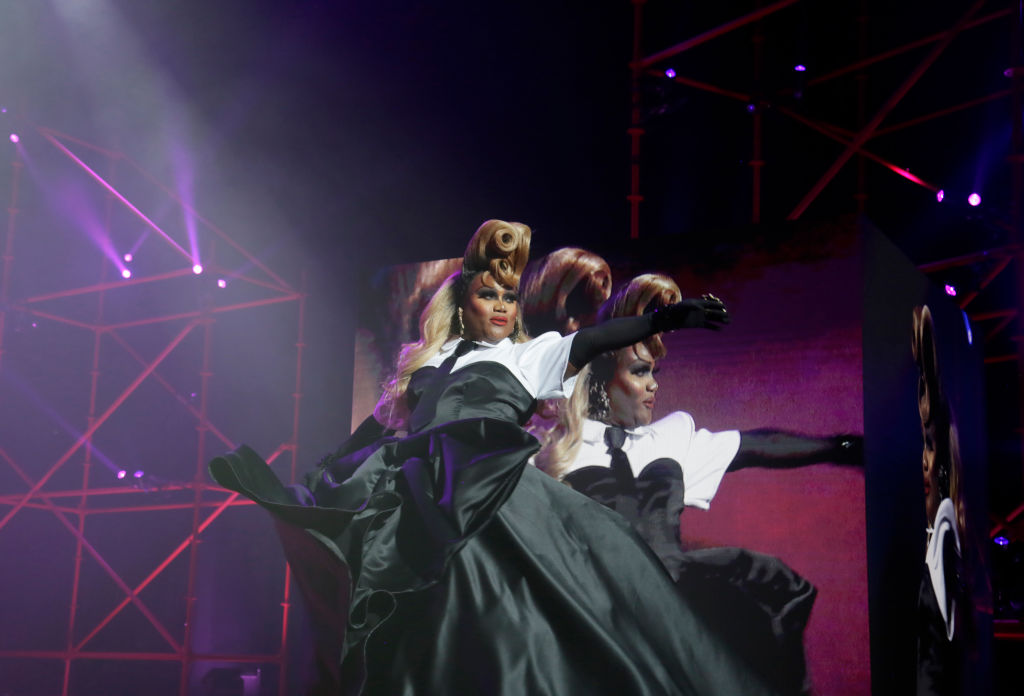
Just to add a dimension to the conversation that I feel is lacking, I think we should avoid blanket statements such as “Black men in drag=BAD.” There are Black men who dress in drag as an expression of their nuanced gender identity and queerness. I think another problem is that when straight-presenting Black men in Hollywood do it without any on- or off-screen analysis of what it says about gender and sexuality to perform what is in fact a queer identity, Black queerness goes yet again overlooked (& mocked).
This is indeed very cool! I adore lots of black men myself because I believe they are genuinely talented.